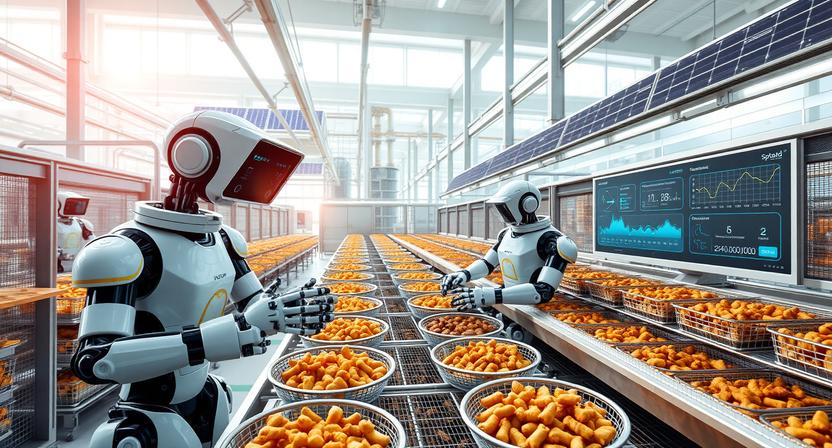
6. Expected
Outcomes
·
Efficiency Gains: 20-30% increase
in processing throughput.
·
Quality Improvement: Consistent
product standards, reduction in defects.
·
Cost Savings: Reduced fuel and
energy costs by optimizing usage.
·
Operational Reliability: Minimized
downtime through predictive maintenance.
·
Community Impact: Empowered local
producers with smart technology, increased income, and sustainable practices.
7. Conclusion
This AI project offers a transformative approach to
sustainable food processing, combining advanced technology with community
needs. It aligns with goals for environmental sustainability, economic
development, and food security.
Selected
Technologies
1. IoT
Sensors
·
Purpose: Collect
real-time environmental and equipment data.
·
Examples: Temperature
sensors, humidity sensors, solar irradiance sensors, vibration sensors, fuel
level sensors.
·
Technologies: Arduino,
Raspberry Pi, ESP8266/ESP32 modules, industrial-grade sensors.
2. Cloud
Computing & Data Storage
·
Purpose: Store
and process large volumes of sensor data.
·
Platforms: Amazon
Web Services (AWS), Microsoft Azure, Google Cloud Platform, or local servers.
·
Technologies: Cloud
databases (e.g., AWS DynamoDB, Azure SQL), IoT data pipelines (AWS IoT Core,
Azure IoT Hub).
3. Machine
Learning & AI Models
·
Purpose: Optimize processes,
predict failures, and automate quality checks.
Frameworks
& Libraries:
·
TensorFlow
& Keras: For developing deep learning
models, including CNNs for image analysis.
·
scikit-learn: For
traditional ML algorithms like regression, classification.
·
LSTM
Networks (Long Short-Term Memory): For time-series
prediction of equipment failures.
·
Reinforcement
Learning: For adaptive process control (if applicable).
4. Computer
Vision
·
Purpose: Automated
inspection of dried/hydrated products.
·
Technologies: OpenCV,
TensorFlow Object Detection API, pre-trained CNN architectures (e.g., ResNet,
MobileNet).
5. Control
& Automation
·
Purpose: Automate adjustments to
drying/hydrating parameters.
·
Technologies: Programmable Logic
Controllers (PLCs), microcontrollers (Arduino, Raspberry Pi), MQTT protocol for
messaging.
6. User
Interface & Visualization
·
Purpose: Real-time
dashboards and remote control.
·
Platforms: Web-based
dashboards using React, Angular, or Vue.js.
·
Visualization
Tools: Grafana, Power BI, or custom dashboards.
7. Integration
& Communication Protocols
·
MQTT: Lightweight messaging
protocol for IoT device communication.
·
REST API: Interface for data
exchange between AI models and control systems.
Summary:
|
Technology Category
|
Specific Technologies
|
Use Case
|
|
Sensors & Hardware
|
Arduino, Raspberry Pi, ESP32, Industrial Sensors
|
Data acquisition from environment & equipment
|
|
Cloud Platforms
|
AWS, Azure, Google Cloud
|
Data storage, model deployment, remote access
|
|
Machine Learning Frameworks
|
TensorFlow, Keras, scikit-learn
|
Process optimization, predictive maintenance
|
|
Computer Vision
|
OpenCV, TensorFlow Object Detection
|
Quality inspection of products
|
|
Automation & Control
|
PLCs, MQTT, Microcontrollers
|
Process control and automation
|
|
User Interface
|
React, Angular, Grafana
|
Monitoring dashboards and alerts
|
Detailed
Technologies and Hardware Recommendations for AI-Driven Sustainable Food
Processing System
1. IoT
Sensors & Hardware
|
Component
|
Model / Technology
|
Purpose
|
Notes
|
|
Temperature Sensor
|
DS18B20 Digital Temperature Sensor
|
Measure drying/hydrating temperature
|
Waterproof, accurate
|
|
Humidity Sensor
|
DHT22 or SHT31
|
Measure ambient humidity
|
Compatible with microcontrollers
|
|
Solar Irradiance Sensor
|
Apogee SI-111 or similar
|
Measure sunlight intensity
|
For solar drying optimization
|
|
Vibration Sensor
|
SW-420 Vibration Sensor Module
|
Monitor machine vibrations
|
Detect equipment anomalies
|
|
Fuel Level Sensor
|
Ultrasonic or Capacitive Fuel Sensors
|
Monitor fuel levels
|
Ensures continuous operation
|